
INTERNAL R&D · WEARABLE BIOELECTRONICS · IN PROGRESS
Movement ML: A Research Workflow for Gait Classification
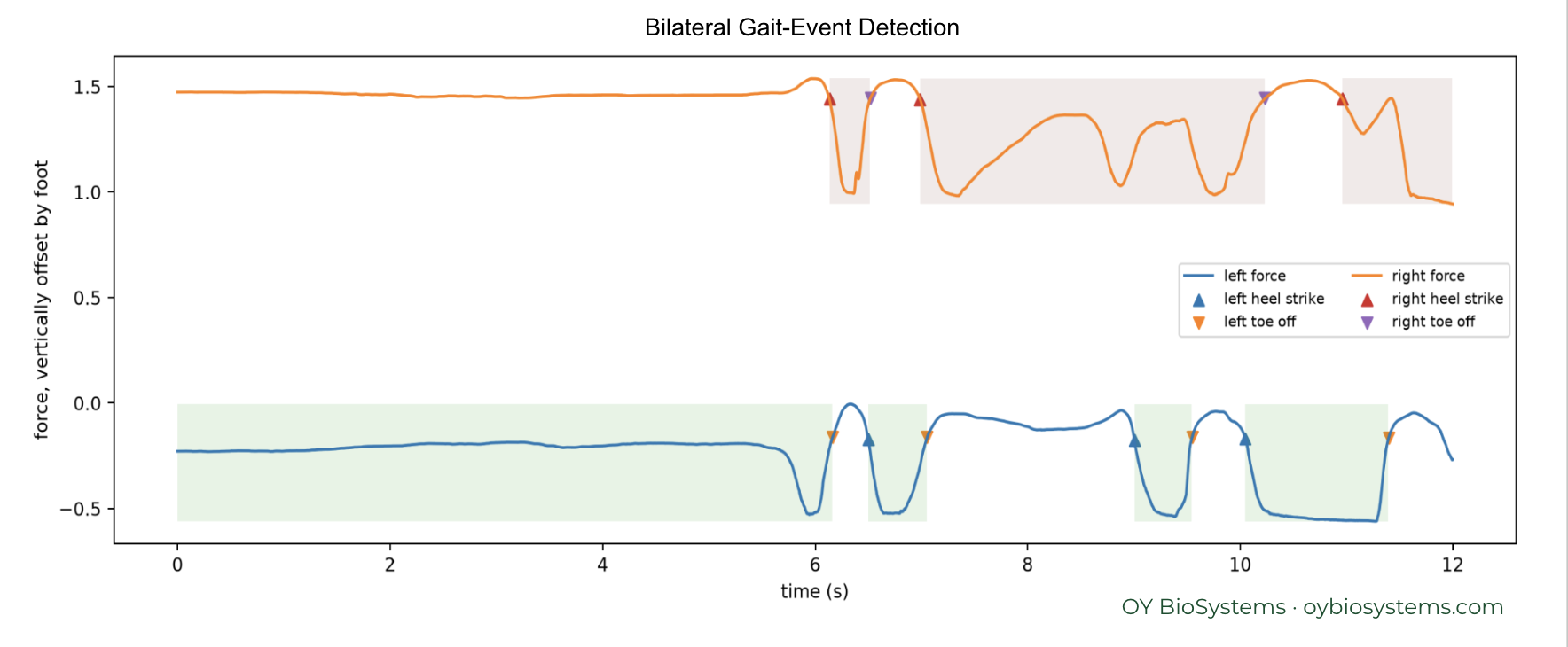
An OY BioSystems research and training initiative exploring how bilateral gait signals can be processed, modeled, and evaluated through a reproducible machine-learning workflow.
Example bilateral force-proxy signal illustrating the workflow’s gait-event detection stage.
Project at a glance
DATA
PhysioNet gait datasets
PRIMARY COHORT
165 participants
CURRENT STAGE
Research prototype
VALIDATION
Subject-disjoint
The Challenge
Turning movement signals into reliable evidence
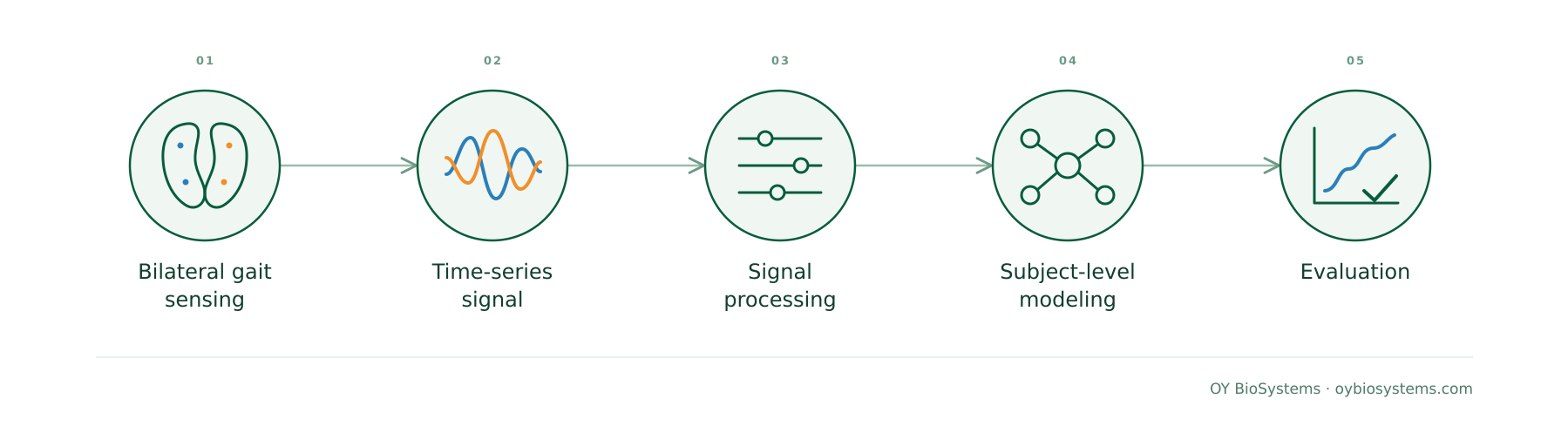
Wearable motion sensors produce continuous signals rather than direct clinical conclusions. Building a meaningful workflow requires careful data selection, validated signal processing, participant-level separation, and comparison with simple clinical measures.
Choosing data that answers the right question
To establish a rigorous foundation for Movement ML, our team evaluated existing plantar-force datasets as methodological proxies for bilateral gait analysis. We assessed each dataset based on clinical relevance, participant diversity, sensor configuration, recording duration, metadata quality, licensing, and validation risks.
This strategy led us to select PhysioNet gaitpdb as the primary Parkinson’s-versus-control development dataset, while retaining GaitNDD as a secondary multiclass and long-duration benchmark. These datasets support workflow development and methodological testing before future validation on target MEG/TENG hardware.
Public force-sensor proxy datasets selected for the Movement ML development workflow. HC: healthy control; PD: Parkinson’s disease; HD: Huntington’s disease; ALS: amyotrophic lateral sclerosis.”
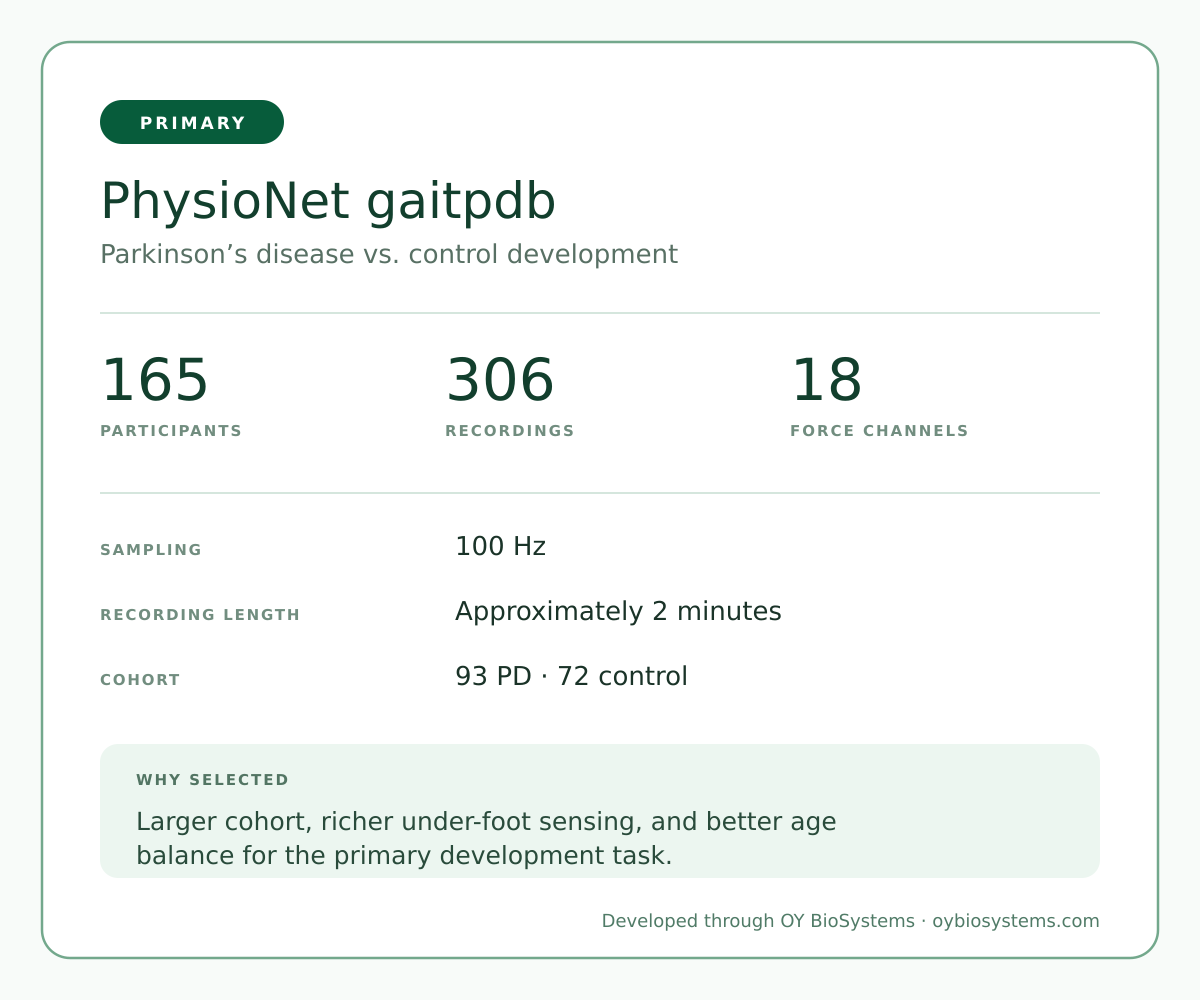
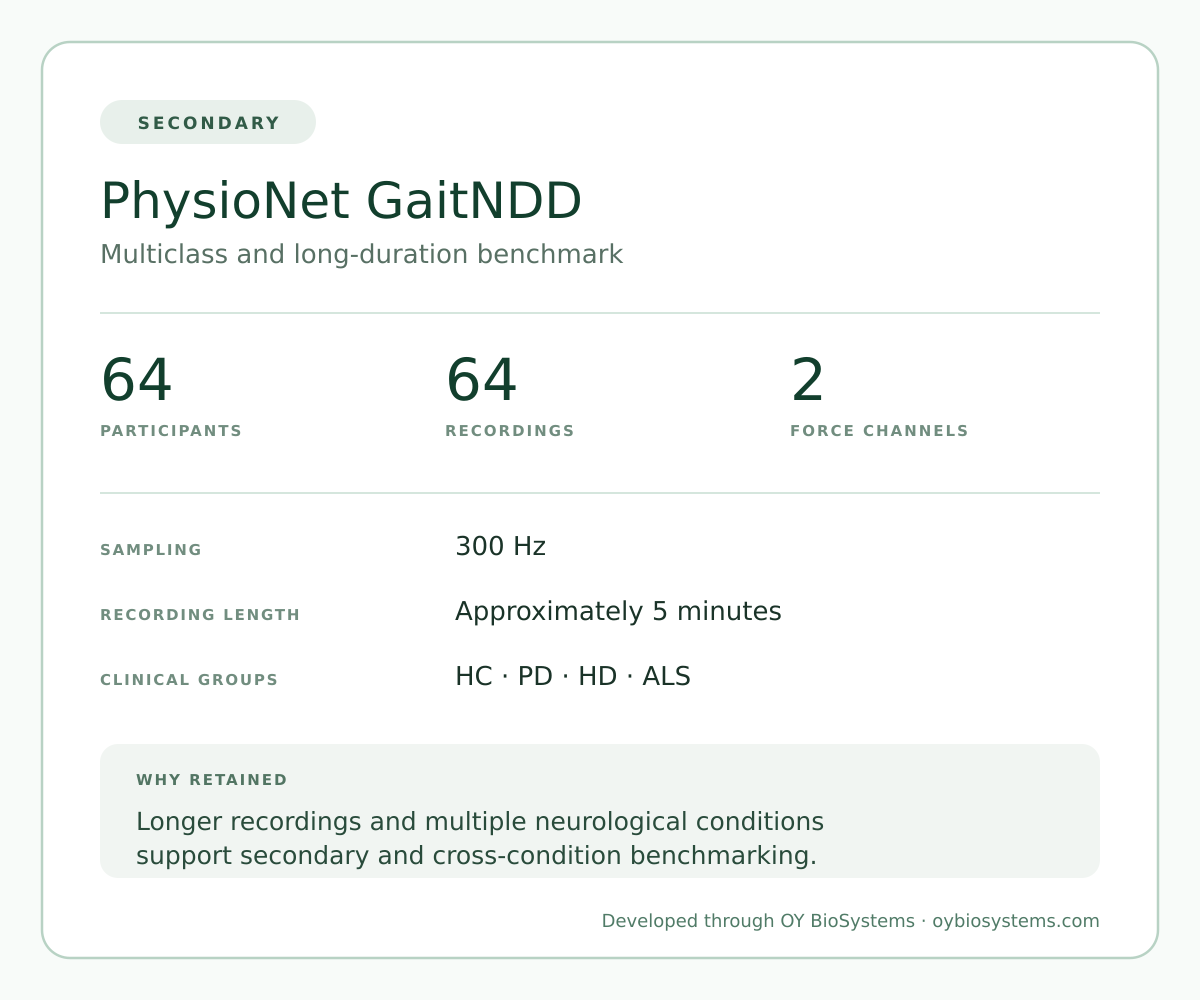
Dataset comparison and selection analysis by Rinat Rizvanov, completed as part of the OY BioSystems Movement ML team.
Before evaluating sensor-based models, the team examined how well participant labels could be predicted from metadata alone. This helped identify whether a model might learn demographic differences instead of disease-related gait characteristics.
Why cohort composition mattered
Age separated Parkinson’s participants from controls much more strongly in GaitNDD than in gaitpdb, supporting gaitpdb as the more appropriate primary development dataset. GaitNDD age-only AUC 0.887 versus gaitpdb 0.593.
Key comparison
A complete, leakage-resistant workflow
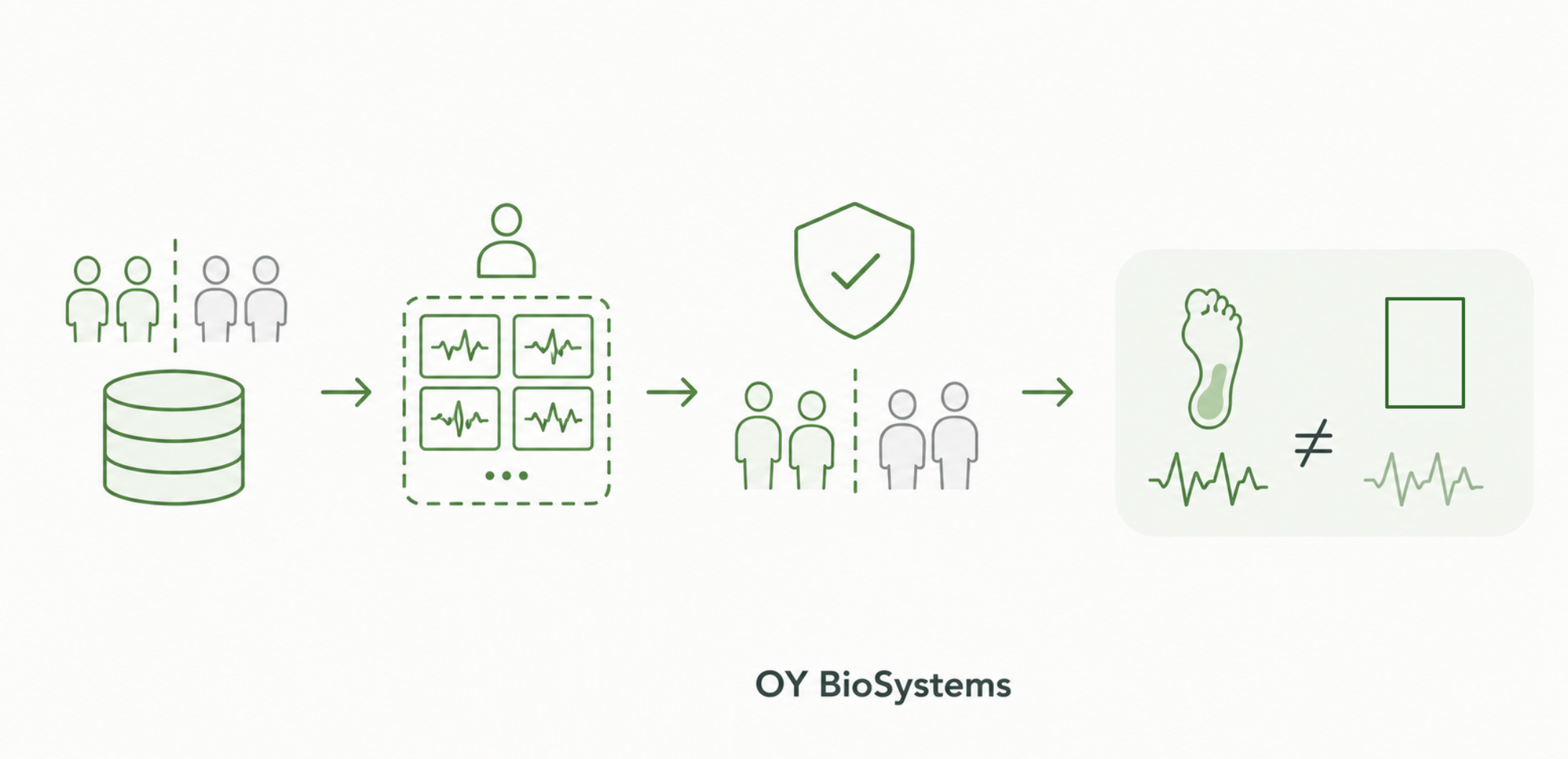
The workflow connects bilateral sensing, signal processing, participant-level modeling, and evaluation while keeping the clinical unit—the participant—at the center of every validation decision
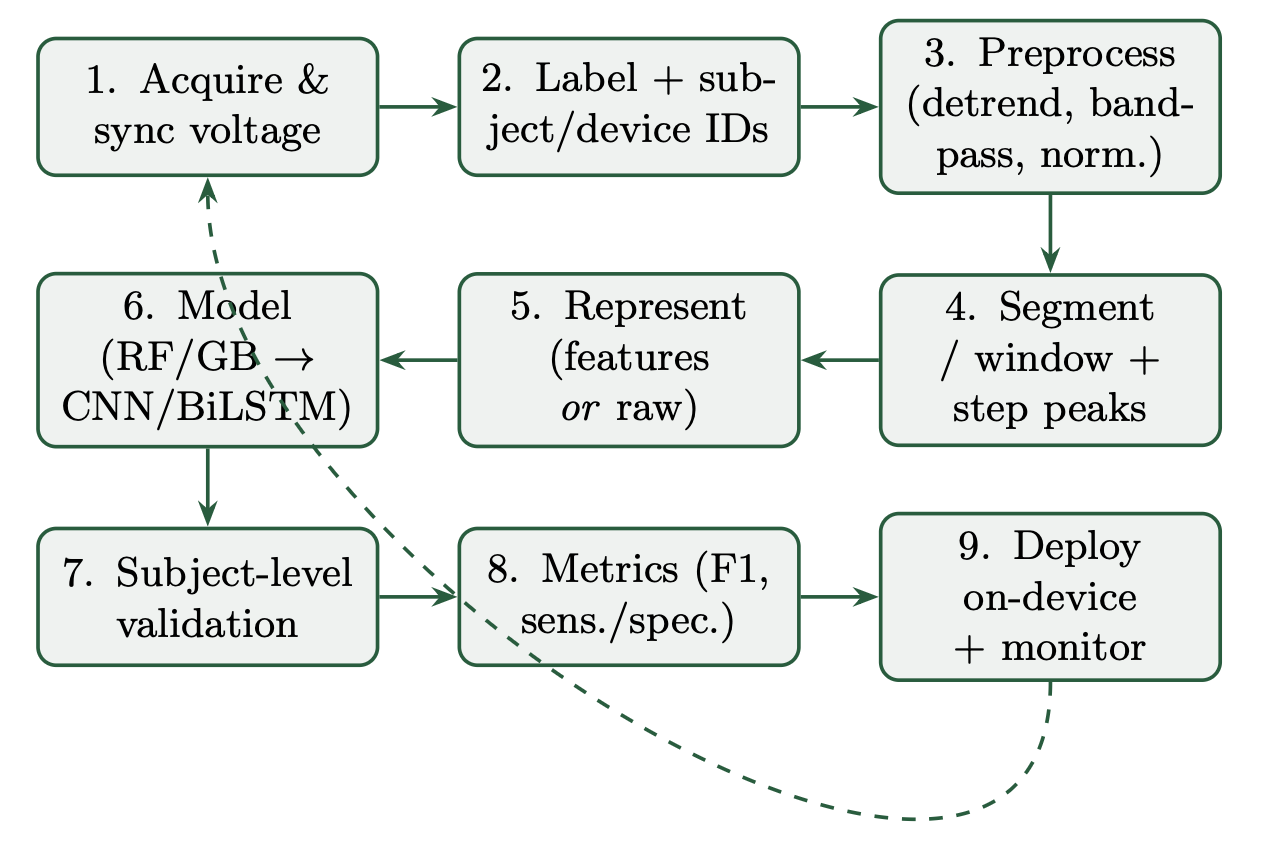
Developed by Miras Koilybay and the OY BioSystems Movement ML team.
From framework to tested research prototype
Movement ML progressed from an initial transducer-agnostic workflow and reference implementation into a public-data pipeline with dataset loaders, quality control, gait-event detection, leakage-safe modeling, clinical comparators, calibration, automated tests, and reproducible outputs.
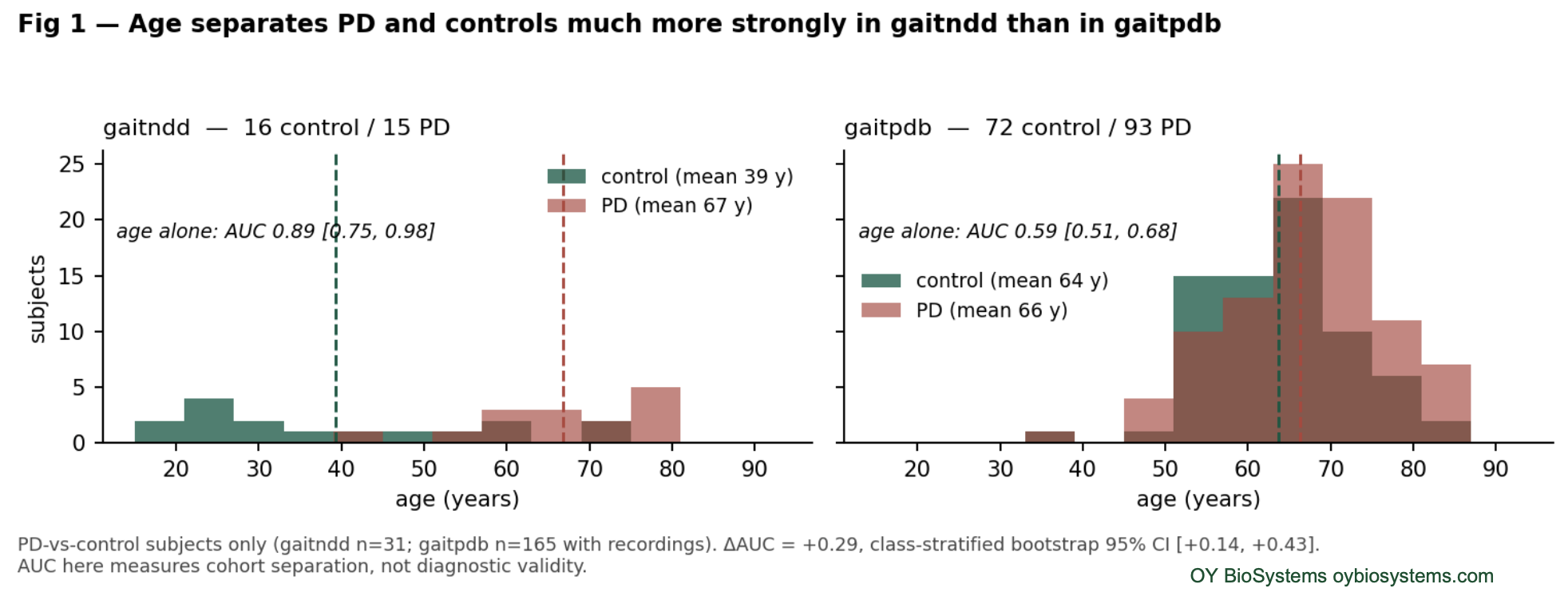
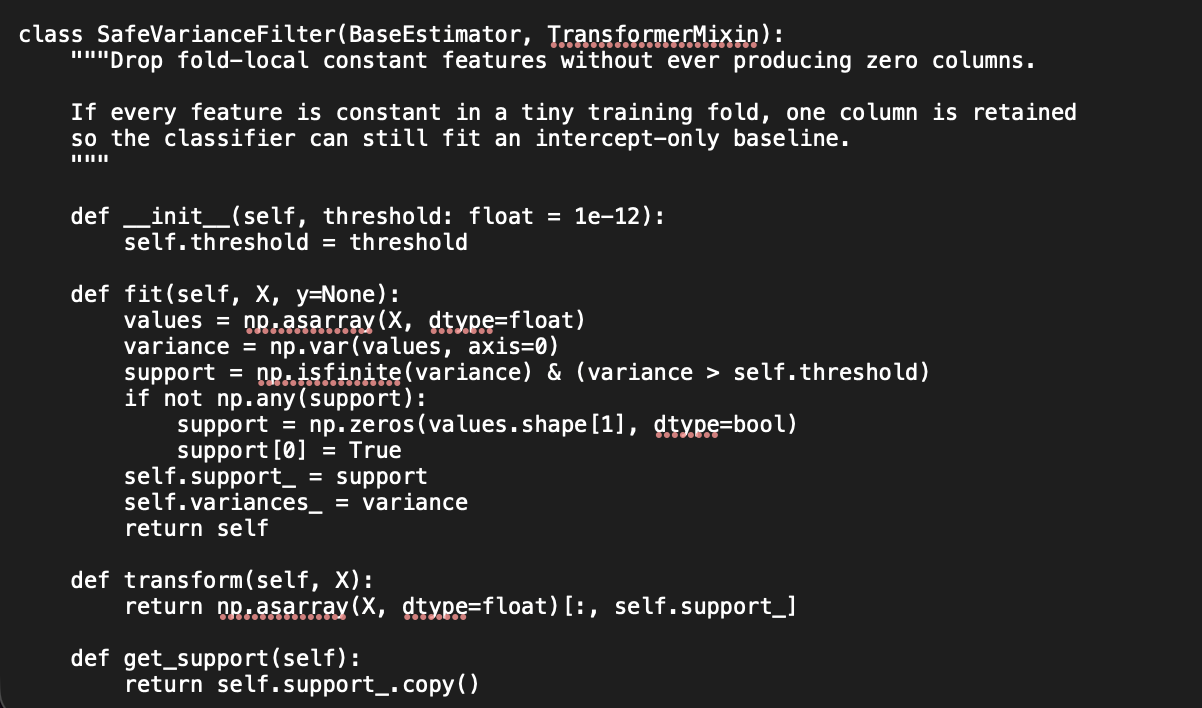
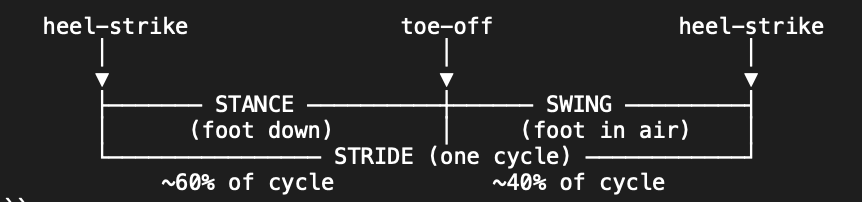
Prototype discerned and completed by Rinat Rizvanov and Miras Koilybay OY BioSystems Movement ML team.
What the public-data benchmark showed
The workflow was evaluated at the participant level using public bilateral force-proxy data. Rather than relying on a single performance score, the analysis compared sensor-waveform features with demographic and clinical baselines using identical subject-level folds and paired bootstrap confidence intervals.
Supported finding: Sensor-waveform features outperformed demographic information by a paired AUC difference of +0.232 (95% CI +0.112 to +0.343), providing evidence that the workflow captured gait-related signal rather than relying primarily on participant characteristics.
Not yet established: Although sensor plus clinical features produced the highest observed AUC of 0.839, the improvement over clinical measures alone was not statistically established: paired ΔAUC +0.042 (95% CI −0.028 to +0.108).
Limitation: Toe-off-dependent measures, including double support, were excluded because their detection did not meet the project’s ground-truth validation requirements.
Conclusion: These results support the methodology as a research and software prototype. External validation using paired recordings from the intended MEG/TENG hardware remains necessary before device-level or clinical claims.
What the evidence changed
Dataset selection affects validity: A technically convenient dataset can still produce misleading results when participant groups differ substantially in age or other metadata.
Evaluation must follow the participant: Separating signal windows is insufficient when several windows come from the same person. Evaluation must remain subject-disjoint.
Proxy data has clear limits: Plantar-force data can support software development, but it does not establish performance on MEG or TENG sensor outputs.
Moving toward target-sensor validation
The next meaningful step is not simply a more complex model. It is collecting paired recordings from the intended sensor and a reference measurement system, followed by external validation, calibration, and prospective testing.
Built through collaborative technical training
Movement ML is being developed through OY BioSystems’ internal technical training program, bringing together bioengineering, data analytics, and machine-learning contributors around a shared research workflow.
The project combines team-level implementation with individually led work in dataset selection, framework development, pipeline validation, and technical review.
Methods, sources, and current limitations
This is an ongoing technical training and software-development project using public force-sensor data as a proxy. It is not a medical device or clinical diagnostic, and its results do not validate performance on MEG/TENG hardware.
Building a biosignal or health-data workflow?
OY BioSystems supports early-stage teams with computational development, technical workflows, and applied machine-learning projects.